
rizer.io.lxcat#
Read and write [LXCat] database.
Exceptions#
Common base class for all non-exit exceptions. |
Classes#
Module Contents#
- class rizer.io.lxcat.Collision#
Dataclass to store collision information.
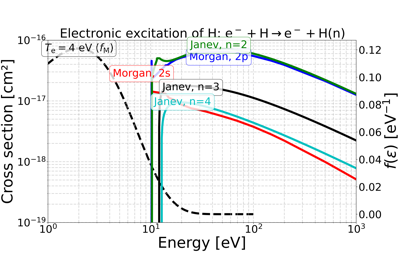
Plot electron-impact cross sections for atomic hydrogen.
Plot electron-impact cross sections for atomic hydrogen.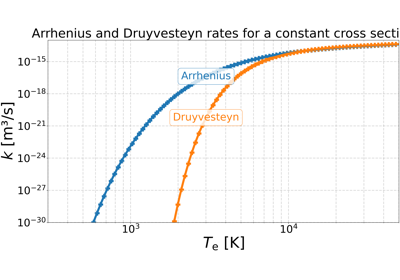
Plot Arrhenius and Druyvesteyn rates for a given cross section.
Plot Arrhenius and Druyvesteyn rates for a given cross section.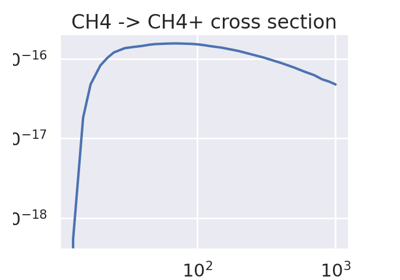
Cross sections and reaction rate constant for the ionisation of CH₄ by electrons.
Cross sections and reaction rate constant for the ionisation of CH₄ by electrons.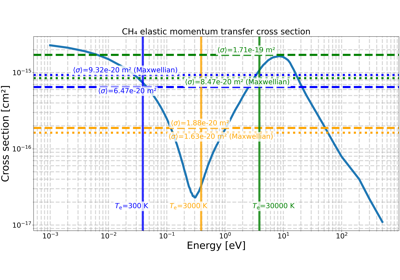
Plot CH₄ average and elastic momentum transfer cross sections.
Plot CH₄ average and elastic momentum transfer cross sections.- energy_eV: numpy.ndarray#
Energy in eV.
- cross_section_cm2: numpy.ndarray#
Cross section in cm^2.
- class rizer.io.lxcat.Species#
Dataclass to contain species collisions information.
- exception rizer.io.lxcat.DuplicateError#
Bases:
ExceptionCommon base class for all non-exit exceptions.
- class rizer.io.lxcat.LXCat(verbose: bool = True, replace_duplicates: bool = False)#
Class to read or write a LXCat database.
- Parameters:
Examples
>>> from rizer.misc.utils import get_path_to_data
>>> from rizer.io.lxcat import LXCat
>>> bolsigdb = get_path_to_data("kin", "bolsigdb", "LXCat-default.txt")
>>> LX = LXCat(verbose=False)
>>> LX.read(bolsigdb)
['Ar', 'CH4', 'CF4', 'Cl2', 'CO2', 'Cu', 'F2', 'H2', 'HCl', 'He', 'Hg', 'Kr', 'N2', 'Ne', 'O2', 'SF6', 'SiH4', 'Xe']
>>> LX.add_species("CO2(v1)", "Vibrationaly excited N2")
>>> cloned = LX.clone_collision(
...     "CO2",
...     "CO2 -> CO2*(7.0eV)",
...     "CO2(v1)",
...     "CO2(v1) -> CO2*(7.0eV)",
...     shift_ev=-0.291,
... )
>>> import tempfile
>>> from pathlib import Path
>>> with tempfile.TemporaryDirectory() as tmp_dir:
...     LX.export(
...         Path(tmp_dir) / "LXCat-updated.txt", species_names="CO2", overwrite=True
...     )
...
Plot electron-impact cross sections for atomic hydrogen.
Plot electron-impact cross sections for atomic hydrogen.
Plot Arrhenius and Druyvesteyn rates for a given cross section.
Plot Arrhenius and Druyvesteyn rates for a given cross section.
Cross sections and reaction rate constant for the ionisation of CH₄ by electrons.
Cross sections and reaction rate constant for the ionisation of CH₄ by electrons.
Plot CH₄ average and elastic momentum transfer cross sections.
Plot CH₄ average and elastic momentum transfer cross sections.- collision = ['elastic', 'effective', 'rotation', 'excitation', 'ionization', 'attachment']#
- verbose = True#
- duplicate = False#
- species: dict[str, Species]#
Dictionary of species for each species.
Key: Species name Value: Species data
- read(file: str | pathlib.Path, clear: bool = False) list[str]#
Read a LXCat database file.
Call several times to read multiple files. Call
clearto erase the former databases.- Fills the LX object as a dictionary with:
- LX.species[species1] –> Species
.collisions[reaction1] –> Collision .collisions[reaction2] .collisions… .collisions[reactionN]
And each element contains a Collision object.
- Parameters:
file (
pathlib.Pathorstr) – LXCat filename. See below for more details on accepted format.clear (
bool, optional) – If True, former collisions are removed. Default False.
- Returns:
List of species in the database
- Return type:
Notes
LXCat format (see documentation at http://www.bolsig.laplace.univ-tlse.fr/manual.html, section ‘Main input: collision cross section data’)
Each collision process is defined by separate block of data, consisting of
1st line: Keyword in capitals indicating the type of the collision. ‘elastic’, ‘effective’,’ionization’, ‘attachment’, ‘excitation’ or ‘rotation’
2nd line: Name of the target particle species, consisting of a single word without spaces, freely chosen by the user, used by BOLSIG+ to identify the target species when loading the data and defining the gas composition.
3rd line (Optional): One or more parameter values, depending on the collision type as described below (see doc), e.g.threshold energy for inelastic collisions.
4th line (Optional): User comments and reference information, maximum 100 lines. The only constraint on format is that these comment lines must not start with a number.
Finally: Table of the cross section as a function of energy. The table starts and ends by a line of dashes ‘-’ (at least 5), and has otherwise two numbers per line: the energy in eV and the cross section in m2.
- get_species_names(species_names: str | list[str] | None = None) list[str]#
Get every species given.
Accept * as character completion.
- Parameters:
species (
strorlistofstrorNone, optional) – If None, return every species present in database. If str, return it as a list. If * is present, search every species beginning with what is before *. Defaults to None.- Raises:
AssertionError – if one of the species given is not in the database.
- Returns:
List of species.
- Return type:
- get_collisions(species_name: str | list[str] | None = None) list[list[Collision]]#
Get collisions in database.
- get_collisions_names(species_name: str | list[str] | None = None) list[list[str]]#
Get collisions in database.
- export(file_name: pathlib.Path | str = 'bolsigdb.dat', species_names: str | list[str] | None = None, format_: str = 'bolsigdb', overwrite: bool = False) None#
Export database in a bolsigdb or LXCat format.
- Parameters:
file_name (
pathlib.Pathorstr) – File name to export the database.species_names (
strorlistofstrorNone, optional) – Export only given species. If None, everything is exported. Also accepts * as a completion character (e.g.: CO2* will export all species starting with CO2). Default to None.format (
str, optional) – One amongst ‘bolsigdb’ / ‘b’, ‘lxcat’ / ‘l’ file format. Minor changes only (bolsigdb has more detailed comments). Default to ‘bolsigdb’.overwrite (
bool, optional) – Default to False. If False, overwriting an existing file will trigger an error.
- add_collision(species_name: str, reaction: str, rtype: str, eV: numpy.ndarray, cm2: numpy.ndarray, details: str, threshold: float = 0.0, mass_ratio: float = 0.0, comment: str = '', updated: str = '') Collision#
Add a new collision in the database.
- Parameters:
species_name (
str) – New species. E.g. ‘Ar’.reaction (
str) – Collision name. E.g: ‘Ar -> Ar^+’rtype (
str) – Collision type. E.g: IONIZATIONthreshold (
float) – Threshold energy as defined in the details line (0 for elastic collisions). Used to match Bolsig collisions (defined by the threshold energy) and collisions from LXCat.mass_ratio (
float) – m/M as defined in the details line. (only for effective/elastic collisions)eV (
numpy.ndarray) – Energy in eV.cm2 (
numpy.ndarray) – Cross-sections in cm^2.details (
str) – Details. E.g: threshold energy.comment (
str, optional) – Comments. E.g: update date, etc.updated (
str, optional) – Update date.
- Returns:
The created collision.
- Return type:
- clone_collision(old_species_name: str, old_reaction: str, new_species_name: str, new_reaction: str, new_type: str = '', new_details: str = '', new_comment: str = '', new_threshold: float | None = None, shift_ev: float = 0.0, shift_cm2: float = 0.0, write_info: bool = True, positive_ev: bool = True, zero_in_zero: bool = False, ev_factor=1.0) Collision#
Create a new collision from a previous one.
Useful to add an offset in an existing collision. See the scaling model of Fridman used in [Kozak2014] to derive the cross section of vibrational excited states from the cross section of the vibrational ground state.
- Parameters:
old_species (
str) – Old species.old_reaction (
str) – Old reaction. eg: ‘Ar -> Ar^+’new_species_name (
str) – New speciesnew_reaction (
str) – New reaction. eg: ‘Ar -> Ar^+’new_type (
str, optional) – Update information of the new transition. If ‘’, the previous one will be kept. Defaults to ‘’.new_details (
str, optional) – Update information of the new transition. If ‘’, the previous one will be kept. Defaults to ‘’.new_comment (
str, optional) – Update information of the new transition. If ‘’, the previous one will be kept. Defaults to ‘’.new_threshold (
float, optional) – If None, the previous threshold is taken and increased by the shift energy. Defaults to None.shift_ev (
float, optional) – Shift the energy. Negative number will reduce the energy (eV). Defaults to 0.0.shift_cm2 (
float, optional) – Shift the cross-sections. Defaults to 0.0.write_info (
bool, optional) – If True, add cloning information to the comment (date, source, shift…). Defaults to True.positive_ev (
bool, optional) – If True, negative eV are discarded. Defaults to True.zero_in_zero (
bool, optional) – If True, forces cross section to be 0 cm^2 for 0 eV. Defaults to False.
- Raises:
ValueError – new reaction should start with new specie
KeyError – If the old specie is not in the database
KeyError – If a reaction in not in the database for old specie
- Returns:
the cloned collision
- Return type:
References
- add_reverse_reaction(data_blocks: Collision, Ab=None, gf: int = 1, gb: int = 1, delta_e=None, warnings: bool = True) Collision#
Compute reverse reaction cross-section for reaction.
- Parameters:
data_blocks (
Collision) – Collision to reverseAb (
str, optional) – Product specie name (new reactant). If None, read it from data_blocks. Defaults to None.gf (
int, optional) – Degenerescence of first state. Defaults to 1.gb (
int, optional) – Degenerescence of second state. Defaults to 1.delta_e (
float, optional) – Energy threshold of transition (in eV). If None, infer from the minimum energy of the input transition. Defaults to None.warnings (
bool, optional) – Check if Ab in datablocks. Defaults to True.
Examples
>>> from rizer.misc.utils import get_path_to_data
>>> from rizer.io.bolsig import LXCat
>>> bolsigdb = get_path_to_data(
...     "kin",
...     "cross_section",
...     "CO",
...     "CO_LXCat2013.txt",
... )
>>> LX = LXCat(replace_duplicates=False, verbose=False)
>>> path = LX.read(bolsigdb)
>>> LX.add_species("CO(V1)(0.266eV)", "Vibrationaly excited CO")
>>> d = LX.species["CO"].collisions["CO -> CO(V1)(0.266eV)"]
>>> reverse_reaction = LX.add_reverse_reaction(d, gf=1, gb=1)
Notes
Adapted from [Pierrot1999] Eqn. (1.11)
\[A_f + e \rightarrow A_b + e\]Hypothesis: Af and Ab have same mass
According to the detailed balance principle, for a ‘A + B -> C + D’ reaction, we can write for the inverse reaction:
\[\sigma'(\epsilon') = \frac{m_Am_B}{m_Cm_D} \frac{g_Ag_B}{g_Cg_D} \frac{\epsilon}{\epsilon'} \sigma(\epsilon)\]with m the mass, g the degenerence, σ the cross section and ϵ the energy
- delete_reaction(species_name: str, reaction: str, ignore_if_error: bool = False)#
Delete a reaction.
- rename_specie(old_species_name: str, new_species_name: str) None#
Rename specie and the reactions where it is a reactant.
- print_all(species_names: str | list[str] | None = None) str#
Print all species and reactions in database.
- plot(species_name: str, xmin: float = 0.1, xmax: float = 100, ymin: float = 0.01, ymax: float = 1000.0, replace_0_with=0, nfig=None, color='k', legend=False, show=False) tuple[matplotlib.figure.Figure, matplotlib.axes.Axes]#
Plot all cross sections in database for species
species_name.- Parameters:
species_name (
str) – Specie to plot.xmin (
float, optional) – Minimum energy in eV. Defaults to 0.1.xmax (
float, optional) – Maximum energy in eV. Defaults to 100.ymin (
float, optional) – Minimum cross section in cm^2. Defaults to 1e-2.ymax (
float, optional) – Maximum cross section in cm^2. Defaults to 1e3.replace_0_with (
float, optional) – Because we plot in logscale, zero won’t be plotted. As a result, a triangular cross-section defined as x=(1,2,3), y=(0,1,0) will be plotted as a Dirac.replace_0_withshould be used and set to exactly youryminso that the cross-section appear correctly in log scale. Defaults to 0.nfig (
int, optional) – Number of the figure. If None, a new figure is created. Defaults to None.color (
str, optional) – Color of the plot. Defaults to ‘k’.legend (
bool, optional) – If True, add legend. Defaults to False.show (
bool, optional) – If True, show the plot. Defaults to False.
- Return type: