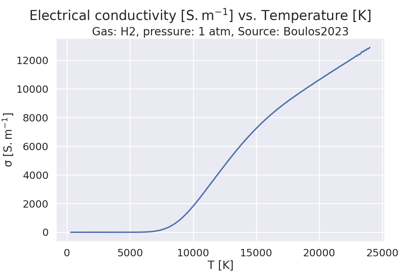
rizer.thermal_plasma.elenbaas_heller#
Classes#
Elenbaas-Heller model for the electrical conductivity of a gas mixture. |
Module Contents#
- class rizer.thermal_plasma.elenbaas_heller.ElenbaasHeller(R: float | int, electric_field: None | float | int, gas_data: rizer.thermal_plasma.fit_LTE_data.FitLTEData, current: None | float | int = None, with_radiation: bool = False, initial_electric_field: float = 1000.0)#
Elenbaas-Heller model for the electrical conductivity of a gas mixture.
It relies on the following main assumptions:
no mass flow,
the temperature is only a function of the radial distance,
the plasma is in local thermodynamic equilibrium (LTE),
the electric field is constant and uniform,
the radiative power is negligible compared to the Joule power and the conductive power (for now).
- Parameters:
electric_field (
Noneorfloatorint, optional) – Electric field, in V/m.current (
Noneorfloatorint, optional) – Current, in A, by default None.gas_data (
FitLTEData) – LTE data for the gas mixture.with_radiation (
bool, optional) – If True, include the (linearized) radiative loss in the arc channel, by default False. The net emission coefficient is linearized about \(\theta_\sigma\) exactly as \(\sigma\) is, giving \(4\pi\,\text{NEC}(\Theta) = b(\Theta - \theta_\sigma)\) with \(b = 4\pi a_\varepsilon\). Radiation is an energy loss, so the arc-channel parameter becomes \(\epsilon = \sqrt{a_\sigma E^2 - b}\); withwith_radiation=False(b = 0) the model is unchanged.bdepends on the radiation source andemission_radius_mmofgas_data. If the loss exceeds the Joule heating (\(a_\sigma E^2 \leq b\)) no steady arc exists and aValueErroris raised.initial_electric_field (
float, optional) – Initial electric field for the solver, by default 1000.0 V/m.
Notes
The Elenbaas-Heller equation is given by (see [Elenbaas1951], and Eq. 8 of Chapter 12 in [Boulos2023]):
\[\frac{1}{r} \frac{d}{dr} \left( r \kappa(T) \frac{dT}{dr} \right) + \sigma(T) E^2 - P^{rad}(T)= 0\]where:
\(r\) is the radial distance,
\(\kappa(T)\) is the thermal conductivity,
\(T\) is the temperature,
\(\sigma(T)\) is the electrical conductivity,
\(E\) is the electric field (assumed to be constant and uniform),
\(P^{rad}(T)\) represents energy losses by radiation per unit volume and unit time.
Neglecting the radiative power, the Elenbaas-Heller equation becomes:
\[\frac{1}{r} \frac{d}{dr} \left( r \kappa(T) \frac{dT}{dr} \right) + \sigma(T) E^2 = 0\]Introducing the integrated thermal conductivity \(\Theta(T) = \int_0^T \kappa(s) ds\), the Elenbaas-Heller equation becomes:
\[\frac{1}{r} \frac{d}{dr} \left( r \frac{d\Theta}{dr} \right) + \sigma(\Theta) E^2 = 0\]Following the method of [Gueye2017], the electrical conductivity can be approximated as a piecewise linear function of the integrated thermal conductivity:
\[\begin{split}\sigma(\Theta) = \begin{cases} 0 & \text{if } \Theta < \theta_\sigma (r \in ]r_0, R])\\ a_\sigma (\Theta - \theta_\sigma) & \text{if } \Theta \geq \theta_\sigma (r \in [0, r_0]) \end{cases}\end{split}\]where:
\(a_\sigma\) is the slope of the electrical conductivity vs. integrated thermal conductivity, in (S/m)/(W.m^-1),
\(\theta_\sigma\) is the first value of the integrated thermal conductivity where the electrical conductivity is non-zero, in W/m,
\(r_0\) is the inner (arc) radius, in m, such that radius lower than \(r_0\) corresponds to non-zero electrical conductivity, and radius greater than \(r_0\) corresponds to zero electrical conductivity,
\(R\) is the outer (torch) radius, in m.
With the following boundary conditions:
At the wall, \(\Theta(r=R) = 0\). Note that \(\Theta\) is the integrated thermal conductivity measured from the lowest tabulated temperature \(T_w\) (the cold-wall temperature, e.g. 300 K), i.e. \(\Theta(T) = \int_{T_w}^{T} \kappa(s)\,ds\), so \(\Theta(R)=0\) corresponds to \(T(R)=T_w\) (the wall temperature), not to 0 K. The original Elenbaas-Heller derivation idealizes \(T_w = 0\), but in practice the wall sits at the lowest temperature in the transport data.
By symmetry, \(\frac{d\Theta}{dr}(r=0) = \left( \frac{dT}{dr} \lambda(T) \right)(r=0) = 0\).
By continuity, \(\Theta(r_0^-) = \Theta(r_0^+) = \theta_\sigma\).
And by continuity of the derivative, \(\frac{d\Theta}{dr}(r_0^-) = \frac{d\Theta}{dr}(r_0^+)\).
The analytical solution to the Elenbaas-Heller equation is then given by:
\[\begin{split}\Theta(r) = \begin{cases} \theta_\sigma \left( 1 + \frac{J_0(\epsilon r)}{J_1(\epsilon r_0)} \frac{1}{r_0 \epsilon \ln(R/r_0)} \right) & \text{if } r \in [0, r_0]\\ \theta_\sigma \frac{\ln(r/R)}{\ln(r_0/R)} & \text{if } r \in ]r_0, R] \end{cases}\end{split}\]where:
\(\epsilon = \sqrt{a_\sigma E^2}\),
\(J_0\) is the Bessel function of the first kind of order 0,
\(J_1\) is the Bessel function of the first kind of order 1.
With radiation (
with_radiation=True), the net emission coefficient is linearized the same way as \(\sigma\):\[\begin{split}4\pi\,\text{NEC}(\Theta) = \begin{cases} b\,(\Theta - \theta_\sigma) & \text{if } \Theta > \theta_\sigma\;(r \in [0, r_0[)\\ 0 & \text{if } \Theta \leq \theta_\sigma\;(r \in\, ]r_0, R]) \end{cases}\end{split}\]so the hot-zone equation becomes \(\frac{1}{r}\frac{d}{dr}(r\frac{d\Theta}{dr}) + (\Theta - \theta_\sigma)(a_\sigma E^2 - b) = 0\) (radiation subtracts, being an energy loss). The solution keeps the same form with \(\epsilon = \sqrt{a_\sigma E^2 - b}\) (and \(b = 4\pi a_\varepsilon\)); \(r_0 \epsilon\) is still a zero of \(J_0\). Setting \(b = 0\) recovers the radiation-free model above.
Examples

Steady LTE arc column: Cantera 1D solver vs analytical Elenbaas-Heller
Steady LTE arc column: Cantera 1D solver vs analytical Elenbaas-Heller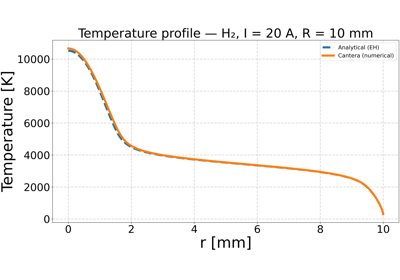
Elenbaas-Heller model for H₂ DC plasma — Cantera numerical solver.
Elenbaas-Heller model for H₂ DC plasma — Cantera numerical solver.- gas_data#
- a_sigma#
- theta_sigma#
- temperature#
- theta#
- with_radiation = False#
- b_rad#
- initial_electric_field = 1000.0#
- analytical_theta_vs_radius(r: float) float#
Analytical solution to the Elenbaas-Heller equation.
- Parameters:
r (
float) – Radial distance.- Returns:
Integrated thermal conductivity at radial distance r.
- Return type:
- Raises:
ValueError – If r is not between 0 and R.
Notes
The analytical solution to the Elenbaas-Heller equation is given by:
\[\begin{split}\Theta(r) = \begin{cases} \theta_\sigma \left( 1 + \frac{J_0(\epsilon r)}{J_1(\epsilon r_0)} \frac{1}{r_0 \epsilon \ln(R/r_0)} \right) & \text{if } r \in [0, r_0]\\ \theta_\sigma \frac{\ln(r/R)}{\ln(r_0/R)} & \text{if } r \in ]r_0, R] \end{cases}\end{split}\]where:
\(\epsilon = \sqrt{a E^2}\), with \(a\) the constant, slope of the electrical conductivity \(\sigma\) vs. integrated thermal conductivity \(\Theta\), and \(E\) the electric field,
\(\theta_\sigma\) is the constant, initial value of the thermal conductivity,
\(J_0\) is the Bessel function of the first kind of order 0,
\(J_1\) is the Bessel function of the first kind of order 1,
\(r_0\) is the inner radius, which should be such that \(r_0 \sqrt{a E^2}\) is a zero of the Bessel function \(J_0\),
\(R\) is the outer radius.
- get_inner_radius(nth_zero: int = 0) float#
Get the inner radius.
- Parameters:
nth_zero (
int, optional) – Nth zero of the Bessel function \(J_0\), by default 0.- Returns:
Inner radius.
- Return type:
Notes
The inner radius is such that \(r_0 \epsilon\) is a zero of the Bessel function \(J_0\), with \(\epsilon = \sqrt{a_\sigma E^2 - b}\) (\(b\) the linearized radiation slope, subtracted as a loss; \(b = 0\) without radiation).
- analytical_current() float#
Calculate the current.
- Returns:
Current.
- Return type:
Notes
Integrating the current density \(j = \sigma E\) over the cross-section and using the analytical \(\Theta(r)\) gives:
\[I = \frac{2 \pi a_\sigma \theta_\sigma E}{\epsilon^2 \, \ln(R/r_0)}, \qquad \epsilon^2 = a_\sigma E^2 - b\]where:
\(a_\sigma\) is the slope of \(\sigma\) vs. \(\Theta\),
\(\theta_\sigma\) is the constant, initial value of the thermal conductivity,
\(b = 4\pi a_\varepsilon\) is the linearized radiation slope (0 without radiation),
\(E\) is the electric field,
\(R\) is the outer radius,
\(r_0\) is the inner radius, such that \(r_0 \epsilon\) is a zero of the Bessel function \(J_0\).
Without radiation (\(b = 0\), \(\epsilon^2 = a_\sigma E^2\)) this reduces to the classic \(I = 2 \pi \theta_\sigma / (E \ln(R/r_0))\).
- get_electric_field_vs_current(target_current: float, initial_electric_field: float | None = None) float#
Get the electric field.
- Parameters:
- Returns:
Electric field.
- Return type:
Notes
The electric field is such that the analytical current is equal to the target current.
- get_temperature_vs_radius(r: float, initial_temperature: float = 300.0) float#
Get the temperature at a given radial distance.
- Parameters:
- Returns:
Temperature.
- Return type:
Notes
The temperature is such that the integrated thermal conductivity is equal to the integrated thermal conductivity at the radial distance r.
The integrated thermal conductivity is given by:
\[\Theta(T(r)) = \int_0^{T(r)} \kappa(s) ds\]where:
\(\kappa\) is the thermal conductivity,
\(T\) is the temperature.
- compute_radiative_power_density_at_r(r: float) float#
Compute the radiative power density at a given radial distance.
Notes
The radiative power density is given by (see equation 13 in [Gueye2017]):
\[P^{rad} = \vec{\nabla} \cdot \vec{q^{rad}} = 4 \pi \text{NEC}\]where:
\(\text{NEC}\) is the net emission coefficient.
- compare_power_density(r: float) tuple[float, float, float]#
Compare the power density.
- Parameters:
r (
float) – Radial distance.- Returns:
Joule power density, conductive power density, radiative power density.
- Return type:
Notes
The power density is given by:
\[P = \sigma E^2 + \frac{1}{r} \frac{d}{dr} \left( r \frac{d\Theta}{dr} \right) + P^{rad}\]where:
\(\sigma E^2\) is the Joule power density,
\(\frac{1}{r} \frac{d}{dr} \left(r \frac{d\Theta}{dr} \right)\) is the conductive power density,
\(P^{rad}\) is the radiative power density.
\(\sigma\) is the electrical conductivity,
\(E\) is the electric field.
\(\Theta = \int_0^T \kappa(s) ds\) is the integrated thermal conductivity, with \(\kappa\) the thermal conductivity and \(T\) the temperature.