
Examples#

You will find below a series of runnable examples using Rizer.
All examples can be run directly from Codespace.
See also
To find examples covering a specific topic, see the index of example tags.

NRP discharge with the adaptive PulsedPlasmaReactor
1D plasma#
One-dimensional radial plasma models: the transient two-temperature reacting plasma
channel (PlasmaChannel / ChannelReactor1D) and the steady LTE arc column
(ThermalPlasmaColumn1D), together with 0D-vs-1D comparisons (matched, prescribed,
and self-consistent NRP circuit) and the monolithic-CVODE vs operator-split solvers.

1D plasma channel vs 0D reactor on a matched NRP discharge (current & energy)

1D vs 0D on a self-consistent NRP circuit (each closes its own loop)

CH4 plasma channel: field pulse on a pre-ionized channel, then relaxation (n_e video)

Transient radial conduction vs. the analytical infinite-cylinder solution

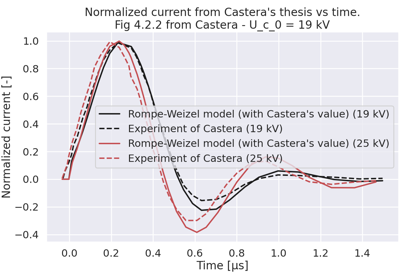
Channel diameter expansion: 1D model vs engineering law vs experiment

Field-driven ionization then relaxation of a 1D plasma channel (n_e video)

Energy-equation effect of species diffusion (compressibility + enthalpy diffusion)


1D plasma channel: operator-split vs monolithic CVODE (same physics)

Steady LTE arc column: Cantera 1D solver vs analytical Elenbaas-Heller
Cantera#
[Cantera] related examples.
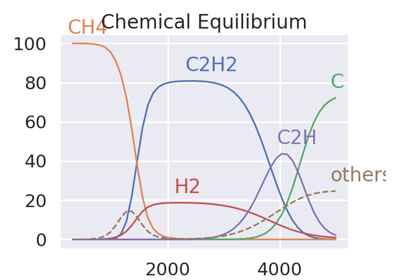
Plot the chemical equilibrium of a given initial solution.

Interactive Reaction Path Diagrams for CH₄ plasma chemistry.
Electric circuit#
A tutorial series on characterizing the pulsed-discharge electrical circuit:
electrical length and the lumped-vs-distributed decision (1), then how to
calibrate the model parameters from what you measure — cable delay and
impedance by TDR (2), loop inductance from the current rise into a dummy load
(3), cable capacitance from the open-end charging transient (4) — and the
LC-ladder picture that ties the calibrations together (5). Companion class:
notebooks/transmission_line_vs_inductance.ipynb. Then, two examples
demonstrating rizer.electrical_model’s circuit/reactor coupling: the same
low-voltage discharge driven by an RLRp vs a CLLRp circuit (6), the same
constant-mass discharge driven by three circuits with very different current
limiting – a transmission line, a direct (unclamped) voltage, and an
RC_Rp_Circuit (7) – and, on the same transmission line, three different
source-side networks – a plain resistive source vs a capacitor shunting the
source’s own output node (c_shunt) vs the same capacitor in parallel with the
source resistance itself (c_parallel) (8).
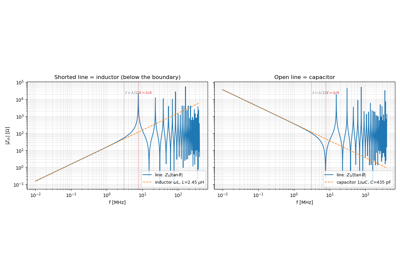
Tutorial 1 — Electrical length: which circuit model does your setup need?
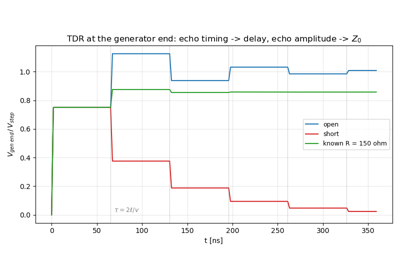
Tutorial 2 — TDR: calibrate the cable delay and impedance from echoes.
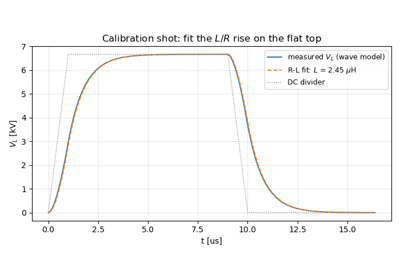
Tutorial 3 — Loop inductance from the current rise into a dummy load.
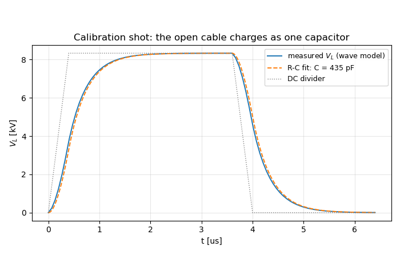
Tutorial 4 — Cable capacitance from the charging transient (no load).
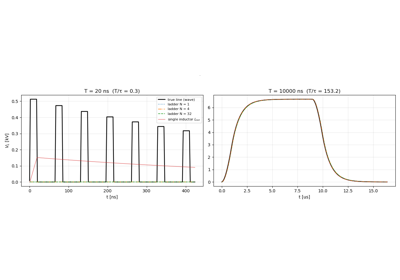
Tutorial 5 — The LC-ladder view: why the calibrations are consistent.
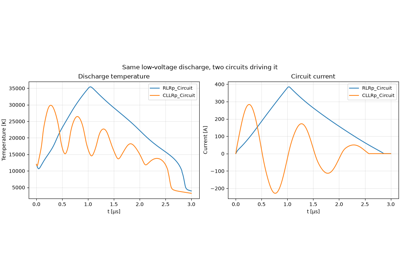
Tutorial 6 — Driving the same low-voltage discharge with two different circuits.
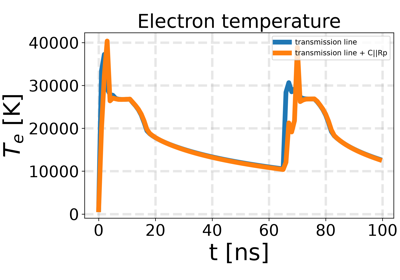
Tutorial 7 — Four circuits driving the same constant-mass discharge.
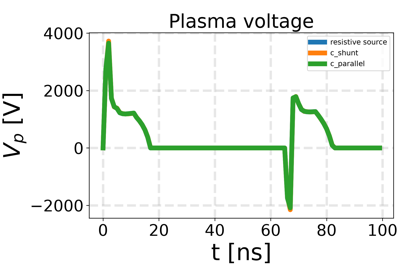
Tutorial 8 — Capacitive source networks: c_shunt vs c_parallel.
Boulder GUI#
Driving rizer’s plasma models from the Boulder
web GUI: the rizer.boulder_plugin package registers the 0D2T NRP discharge
(PlasmaReactor2T), the hybrid ns + low-voltage discharge
(HybridDischarge2T), the adaptive PulsedPlasmaReactor and the spice
circuit simulators (SpiceCircuit) as STONE reactor kinds, with the
electrical circuit expressed as Simulink-style blocks (Generator nodes,
CoaxialCable edges). This directory ships ready-to-run YAML configurations —
launch one with rizer <config.yaml> and inspect the Plasma and
Scope result tabs. See examples/gui/README.md for the full kind
table, output-pane guide and YAML notes.
Input/Output#
Examples related to input and output operations, like how to read and write chemical kinetic data in various formats.

Computing and comparing the properties of an CH_4 plasma.

Example: Calculating the properties of an CH_4 plasma.
Kinetics#
Kinetics related examples, like how to build a chemical mechanism with electrons and visualizing reaction path diagrams.

Add CHEMKIN transport data to a Cantera YAML file.
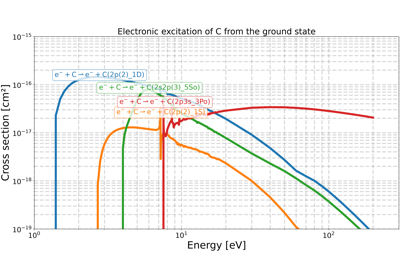
Plot electron-impact cross sections for atomic carbon and rank its reactions.
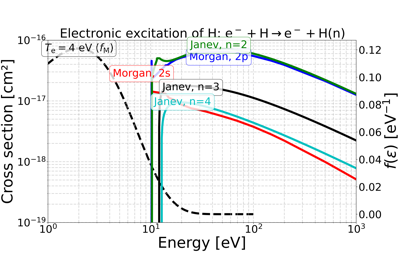
Plot electron-impact cross sections for atomic hydrogen.
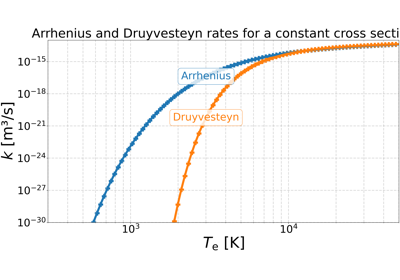
Plot Arrhenius and Druyvesteyn rates for a given cross section.
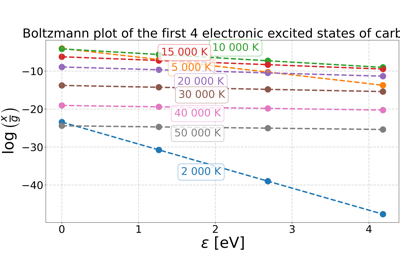
Boltzmann plot of the first electronic excited states of carbon.

Run Bolsig to compute energy fraction loss in CH₄.
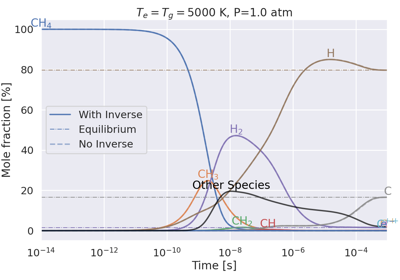
Do we get the same equilibrium with and without inverse reactions?
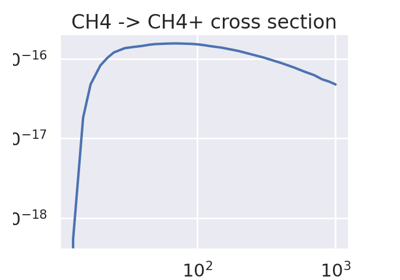
Cross sections and reaction rate constant for the ionisation of CH₄ by electrons.
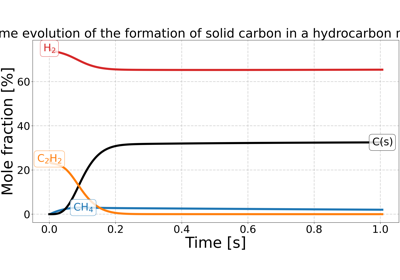
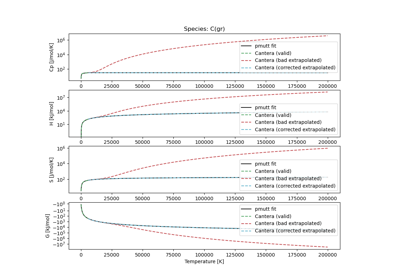
Time evolution of the formation of solid carbon in a hydrocarbon mixture.

Plasma#
Could be NRP plasma, DC plasma, hybrid plasma, or discharge plasma examples.

0D reactor: native C++ vs Python (and the 1D channel collapsed to a single cell).
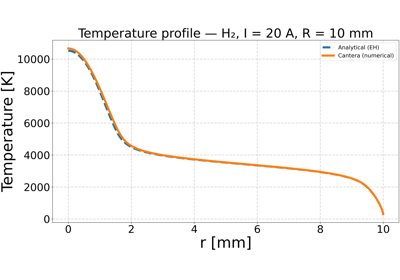
Elenbaas-Heller model for H₂ DC plasma — Cantera numerical solver.
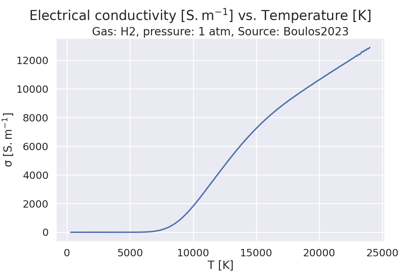
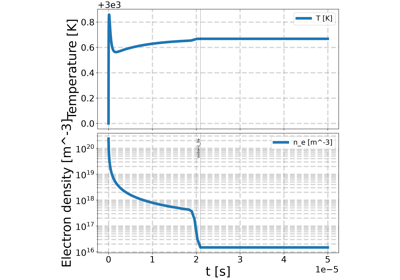
Isobaric chemical relaxation: non-equilibrium n_e collapsing to LTE.
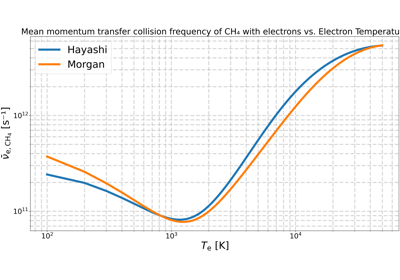
Plot CH₄ average momentum transfer collision frequency.
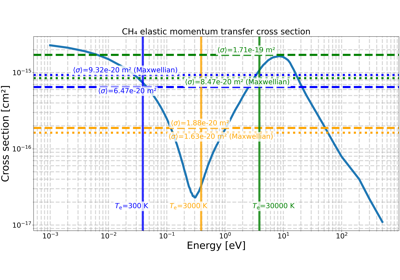
Plot CH₄ average and elastic momentum transfer cross sections.

Use Stine-Watson model for a DC thermal plasma in H₂.
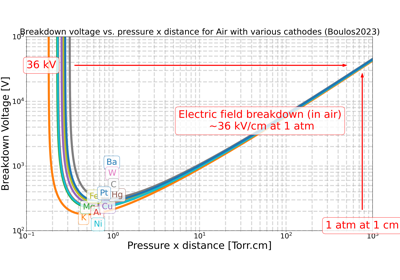
Radiation properties#
Methane and hydrogen radiation properties in Local Thermal Equilibrium (LTE), using the Net Emission Coefficient (NEC) method for now.
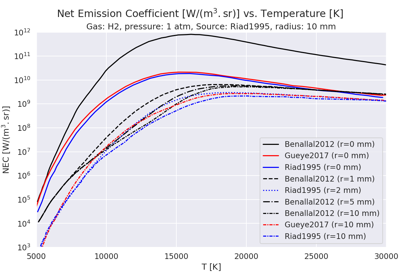
Plot radiation data vs. temperature for CH4, H2 and N2.
Thermodynamic properties#
Methane and hydrogen thermodynamic properties in Local Thermal Equilibrium (LTE) for now, as well as composition at equilibrium for methane and hydrogen.
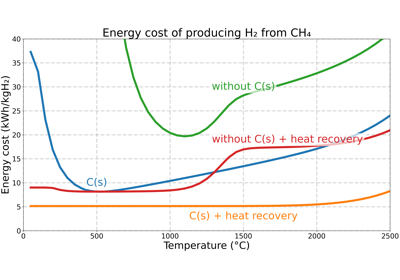
Plot the energy cost of producing H₂ from CH₄ as a function of temperature.
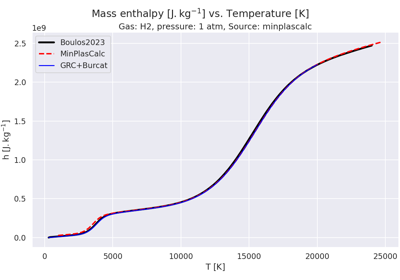
Plot thermodynamic properties of H₂ vs. temperatures.
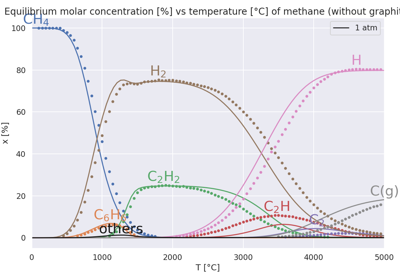
Plot CH₄ chemical equilibrium vs temperature for various pressures (including solid carbon).
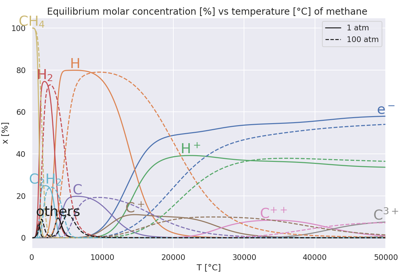
Plot CH₄ chemical equilibrium vs temperature for various pressures (at high temperatures).
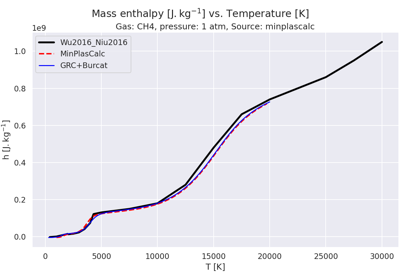
Plot thermodynamic properties of CH₄ vs. temperatures.
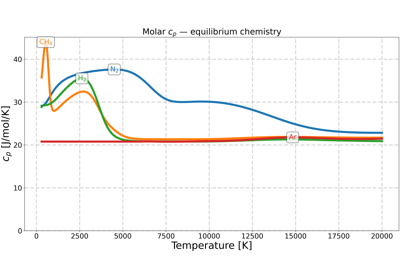
Plot molar heat capacity of N₂, CH₄, H₂ and Ar vs. temperature.
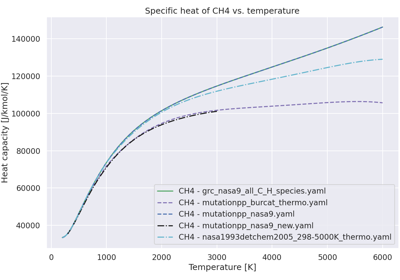
Plot specific heat vs. temperature for different species and thermo data.
Transport properties#
Methane and hydrogen transport properties in Local Thermal Equilibrium (LTE) for now.
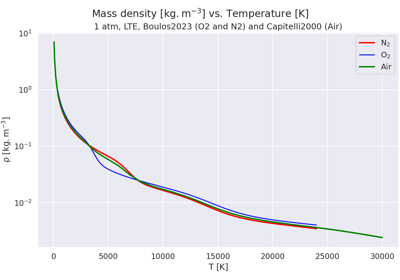
Plot thermodynamic and transport data vs. temperature for a plasma of Air, O2 or N2 in LTE.
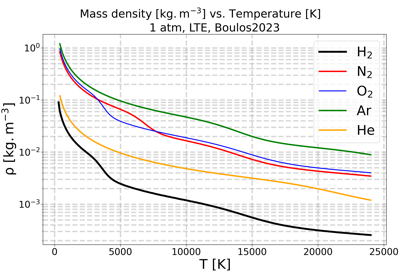
Plot thermodynamic and transport data vs. temperature for a plasma of H2, O2, N2, Ar, He in LTE.
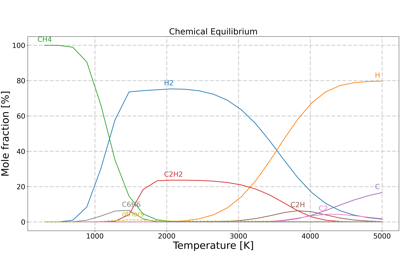
Compare thermal conductivity vs. temperature for a plasma of methane.
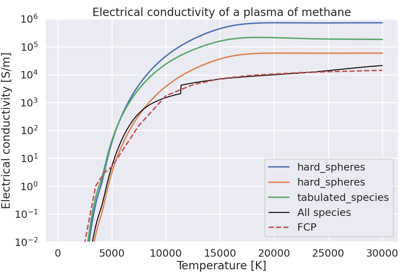
Plot electrical conductivity vs. temperature for a plasma of methane.
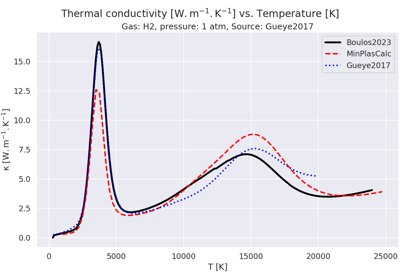
Plot transport data vs. temperature for a plasma of hydrogen.
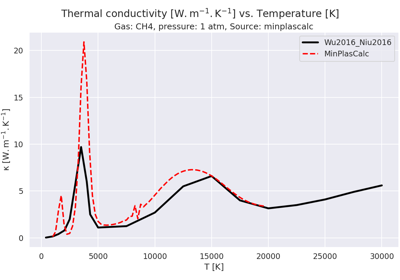
Plot transport data vs. temperature for a plasma of methane.