
Note
Go to the end to download the full example code.
Elenbaas-Heller model for H₂ DC plasma.#
This example demonstrates how to use the Elenbaas-Heller model to compute the temperature and integrated thermal conductivity in a DC plasma.
The Elenbaas-Heller model is a simple analytical model that describes the temperature distribution in a DC plasma torch, at low pressure (typically 1 atm), stabilized by water-cooled walls.
Once the temperature distribution is known, the conductivity of the channel can be determined.
It is based on the following assumptions:
no mass flow in the plasma,
the plasma is in a steady state and is axially symmetric,
there is no magnetic field,
the plasma is in thermal and chemical equilibrium,
gravity, viscous dissipation and thermodiffusion effects are negligible,
there is a cold zone (where the electrical conductivity is zero) around a hot zone (where the electrical conductivity is linear with the integrated thermal conductivity),
Here, the radiative power is neglected (since we are only considering low pressure plasma),
pressure is assumed to be constant (at atmospheric pressure).
In this example, we use the Elenbaas-Heller model, extended by Gueye to compute the temperature and integrated thermal conductivity in a H₂ DC plasma. We first load the transport data from a file and plot the electrical conductivity and thermal conductivity as a function of temperature. We then define the Elenbaas-Heller model and use it to compute the temperature and integrated thermal conductivity as a function of the radial distance. Finally, we plot the temperature as a function of the radial distance for different current values.
Notes#
The Elenbaas-Heller models a DC plasma, by solving the following equation (see [Gueye2017] and [Elenbaas1951] for details):
where:
\(r\) is the radial distance,
\(\kappa(T)\) is the thermal conductivity,
\(T\) is the temperature,
\(\sigma(T)\) is the electrical conductivity,
\(E\) is the electric field,
\(P^{rad}(T)\) is the radiative power.
Introducing the integrated thermal conductivity \(\Theta(T) = \int_0^T \kappa(s) ds\), and neglecting the radiative power, we can rewrite the equation as:
As [Gueye2017] noted, the electrical conductivity of hydrogen can be written as a linear function of the integrated thermal conductivity:
where:
\(a_\sigma\) is the slope of the electrical conductivity vs. integrated thermal conductivity, in (S/m)/(W.m^-1),
\(\theta_\sigma\) is the first value of the integrated thermal conductivity where the electrical conductivity is non-zero, in W/m,
\(r_0\) is the inner (arc) radius, in m, such that radius lower than \(r_0\) corresponds to non-zero electrical conductivity, and radius greater than \(r_0\) corresponds to zero electrical conductivity,
\(R\) is the outer (torch) radius, in m.
We now see that there is a cold zone (where the electrical conductivity is zero) and a hot zone (where the electrical conductivity is linear with the integrated thermal conductivity).
With the following boundary conditions:
At the wall, \(\Theta(r=R) = 0\). Since \(\Theta\) is integrated from the lowest tabulated temperature \(T_w\) (the cold wall, e.g. 300 K), this means \(T(R) = T_w\), the wall temperature — not 0 K (which the original derivation idealizes).
By symmetry, \(\frac{d\Theta}{dr}(r=0) = \left( \frac{dT}{dr} \lambda(T) \right)(r=0) = 0\).
By continuity, \(\Theta(r_0^-) = \Theta(r_0^+) = \theta_\sigma\).
And by continuity of the derivative, \(\frac{d\Theta}{dr}(r_0^-) = \frac{d\Theta}{dr}(r_0^+)\).
The analytical solution to the Elenbaas-Heller equation is then given by:
where:
\(\epsilon = \sqrt{a_\sigma E^2}\),
\(J_0\) is the Bessel function of the first kind of order 0,
\(J_1\) is the Bessel function of the first kind of order 1.
See Also#
# This is an option for the online documentation, so that each image is displayed separately.
# sphinx_gallery_multi_image = "single"
Import the required libraries.#
import matplotlib.pyplot as plt
import numpy as np

from rizer.misc.plt_utils import set_mpl_style
from rizer.models.steady_lte_arc.elenbaas_heller_1D_analytical import ElenbaasHeller
from rizer.models.steady_lte_arc.fit_lte_data import FitLTEData

set_mpl_style(nb_columns=1)
Load transport data and plot them.#
# Load data.
H2_lte_data = FitLTEData(
    gas_name_transport="H2",
    gas_name_radiation="H2",
    pressure_atm=1,
    source_transport="Boulos2023",
    source_radiation="Gueye2017",
    emission_radius_mm=0,
    max_temperature_fit=12000.0,
)

# Plot electrical conductivity vs. temperature.
H2_lte_data.thermo_transport_data.plot(x="T", y="sigma")
# Plot thermal conductivity vs. temperature.
H2_lte_data.thermo_transport_data.plot(x="T", y="kappa")
![Electrical conductivity $\mathregular{[S.m^{-1}]}$ vs. Temperature $\mathregular{[K]}$, Gas: H2, pressure: 1 atm, Source: Boulos2023](../../_images/sphx_glr_plot_elenbaas_heller_model_001.png)
![Thermal conductivity $\mathregular{[W.m^{-1}.K^{-1}]}$ vs. Temperature $\mathregular{[K]}$, Gas: H2, pressure: 1 atm, Source: Boulos2023](../../_images/sphx_glr_plot_elenbaas_heller_model_002.png)
(<Figure size 4800x2700 with 1 Axes>, <Axes: title={'center': 'Gas: H2, pressure: 1 atm, Source: Boulos2023'}, xlabel='$\\mathregular{T}$ $\\mathregular{[K]}$', ylabel='$\\mathregular{\\kappa}$ $\\mathregular{[W.m^{-1}.K^{-1}]}$'>)
Define the Elenbaas-Heller model.#
Note that the parameters electric_field and current are mutually exclusive. If you define one, the other must be set to None.
# Define the parameters.
R = 10e-3  # m
electric_field = 5000  # V/m
current = None  # A
# electric_field = None  # V/m
# current = 10  # A

# Define and resolve the Elenbaas-Heller model.
elenbaas = ElenbaasHeller(
    R,
    electric_field=electric_field,
    current=current,
    gas_data=H2_lte_data,
)
Plot the results in the approximation of the arc channel model.#
# Define the radial distance.
r_values = np.linspace(0, R, num=1000, dtype=float)

# Print the parameters.
print(f"Outer radius R: {elenbaas._R:.2e} m")
print(f"a_sigma: {elenbaas.a_sigma:.2e} (S/m)/(W/m)")
print(f"theta_sigma: {elenbaas.theta_sigma:.2e} W/m")

# Compute the electrical conductivity.
theta = elenbaas.theta

# Plot the electrical conductivity vs. integrated thermal conductivity.
H2_lte_data.fit_electrical_conductivity(sigma_cutoff=100, plot_fit=True)
![Electrical conductivity $\mathregular{[S.m^{-1}]}$ vs. Integrated thermal conductivity $\mathregular{[W.m^{-1}]}$, Gas: H2, pressure: 1 atm, Source: Boulos2023, Max fit T = 12000 K](../../_images/sphx_glr_plot_elenbaas_heller_model_003.png)
Outer radius R: 1.00e-02 m
a_sigma: 2.27e-01 (S/m)/(W/m)
theta_sigma: 2.99e+04 W/m

(np.float64(0.22699241092881833), 29894.450000000008)
Print electric field and current.#
# Print the electric field.
print(f"Electric field: {elenbaas.electric_field:.2e} V/m")
# Compute and print the current.
current = elenbaas.analytical_current()
print(f"Current: {current:.2e} A")
Electric field: 5.00e+03 V/m
Current: 1.64e+01 A
Compute and plot the theta values.#
theta_values = np.array([elenbaas.analytical_theta_vs_radius(r) for r in r_values])

fig, ax = plt.subplots()
ax.plot(r_values * 1e3, theta_values)
ax.set_xlabel("r [mm]")
ax.set_ylabel("Theta [W/m]")
ax.set_title("Integrated thermal conductivity [W/m] versus radial distance [mm]")
plt.show()
![Integrated thermal conductivity [W/m] versus radial distance [mm]](../../_images/sphx_glr_plot_elenbaas_heller_model_004.png)
Compute and plot the temperature values.#
temperature_values = np.array([elenbaas.get_temperature_vs_radius(r) for r in r_values])

fig, ax = plt.subplots()
ax.plot(r_values * 1e3, temperature_values)
ax.set_xlabel("r [mm]")
ax.set_ylabel("Temperature [K]")
ax.set_title("Temperature [K] versus radial distance [mm]")
plt.show()
![Temperature [K] versus radial distance [mm]](../../_images/sphx_glr_plot_elenbaas_heller_model_005.png)
Plot temperature vs. radial distance.#
Plot the temperature vs. radial distance for different current values.
# Define the current values.
intensity_values = [1, 5, 10, 20, 50, 100]  # A

# Define the figure.
fig, ax = plt.subplots()

# Loop over the current values.
for current in intensity_values:
    # Define the Elenbaas-Heller model.
    elenbaas = ElenbaasHeller(
        R,
        electric_field=None,
        current=current,
        gas_data=H2_lte_data,
    )

    # Compute and plot the temperature values.
    temperature_values = np.array(
        [elenbaas.get_temperature_vs_radius(r) for r in r_values]
    )

    ax.plot(r_values * 1e3, temperature_values, label=f"Current: {current} A")

# Set the labels and title.
ax.set_xlabel("r [mm]")
ax.set_ylabel("Temperature [K]")
ax.set_title("Temperature [K] versus radial distance [mm] (R = 10 mm)")
ax.legend()
plt.show()
![Temperature [K] versus radial distance [mm] (R = 10 mm)](../../_images/sphx_glr_plot_elenbaas_heller_model_006.png)
Plot electric fied vs. current.#
The current is given by:
Then, using the computation of the temperature and electric conductivity, this expression reduces to:
where:
\(I\) is the current,
\(\theta_\sigma\) is the constant, initial value of the integrated thermal conductivity,
\(E\) is the electric field,
\(R\) is the outer radius (torch radius),
\(r_0\) is the inner radius (arc radius), such that \(r_0 \sqrt{a E^2}\) is a zero of the Bessel function \(J_0\).
Plot the electric field vs. current for different outer radius.
# Define the outer radius values.
R_values = [10e-3, 20e-3, 50e-3]  # m.

# Define the current values.
current_values = np.linspace(5, 100, 100, dtype=float)  # A

# Define the figure.
fig, ax = plt.subplots()


# Loop over the outer radius values.
for R in R_values:
    electric_field_values = np.zeros_like(current_values)

    for i, current in enumerate(current_values):
        # Define the Elenbaas-Heller model.
        elenbaas = ElenbaasHeller(
            R,
            electric_field=None,
            current=current,
            gas_data=H2_lte_data,
        )

        # Compute the electric field values.
        electric_field_values[i] = elenbaas.electric_field

    ax.plot(current_values, electric_field_values, label=f"R: {R * 1e3} mm")

# Set the labels and title.
ax.set_xlabel("Current [A]")
ax.set_ylabel("Electric field [V/m]")
ax.set_title("Electric field [V/m] versus current [A]")
ax.legend()
plt.show()
![Electric field [V/m] versus current [A]](../../_images/sphx_glr_plot_elenbaas_heller_model_007.png)
Effect of radiation (various emission radii).#
Setting with_radiation=True adds the linearized radiative loss to the arc
channel. The net emission coefficient (NEC) is linearized about
\(\theta_\sigma\) just like the electrical conductivity:
so the arc-channel parameter becomes \(\epsilon = \sqrt{a_\sigma E^2 + b}\).
The NEC (hence b) depends strongly on the assumed emission radius
(self-absorption): a small radius is closer to optically thin and gives a much
larger NEC. Here we sweep emission_radius_mm at a fixed electric field and
compare the radial temperature profiles with the radiation-free case.
# Fixed current
I_rad = 200.0  # A


R = 10e-3  # m

# Radiation-free reference (same transport data as above).
elenbaas_no_rad = ElenbaasHeller(
    R,
    electric_field=None,
    current=I_rad,
    gas_data=H2_lte_data,
)
T_no_rad = np.array([elenbaas_no_rad.get_temperature_vs_radius(r) for r in r_values])

fig, ax = plt.subplots()
ax.plot(r_values * 1e3, T_no_rad, "k", label="No radiation")

# Sweep the emission radius (Benallal2012 provides 1, 5, 10 mm for H₂).
for emission_radius_mm in [1, 5, 10]:
    H2_rad_data = FitLTEData(
        gas_name_transport="H2",
        gas_name_radiation="H2",
        pressure_atm=1,
        source_transport="Boulos2023",
        source_radiation="Benallal2012",
        emission_radius_mm=emission_radius_mm,
        max_temperature_fit=12000.0,
    )
    elenbaas_rad = ElenbaasHeller(
        R,
        electric_field=None,
        current=I_rad,
        gas_data=H2_rad_data,
        with_radiation=True,
        initial_electric_field=1200,
    )
    T_rad = np.array([elenbaas_rad.get_temperature_vs_radius(r) for r in r_values])
    ax.plot(r_values * 1e3, T_rad, label=f"Radiation, {emission_radius_mm} mm")

ax.set_xlabel("r [mm]")
ax.set_ylabel("Temperature [K]")
ax.set_title(f"Effect of radiation on temperature (I = {I_rad} A, R = 10 mm)")
ax.legend()
plt.show()
Also plot the tests.#
from tests.models.steady_lte_arc.test_elenbaas_heller_1D_analytical import (  # noqa: E402, I001
    test_fig13a,
    test_fig13b,
)
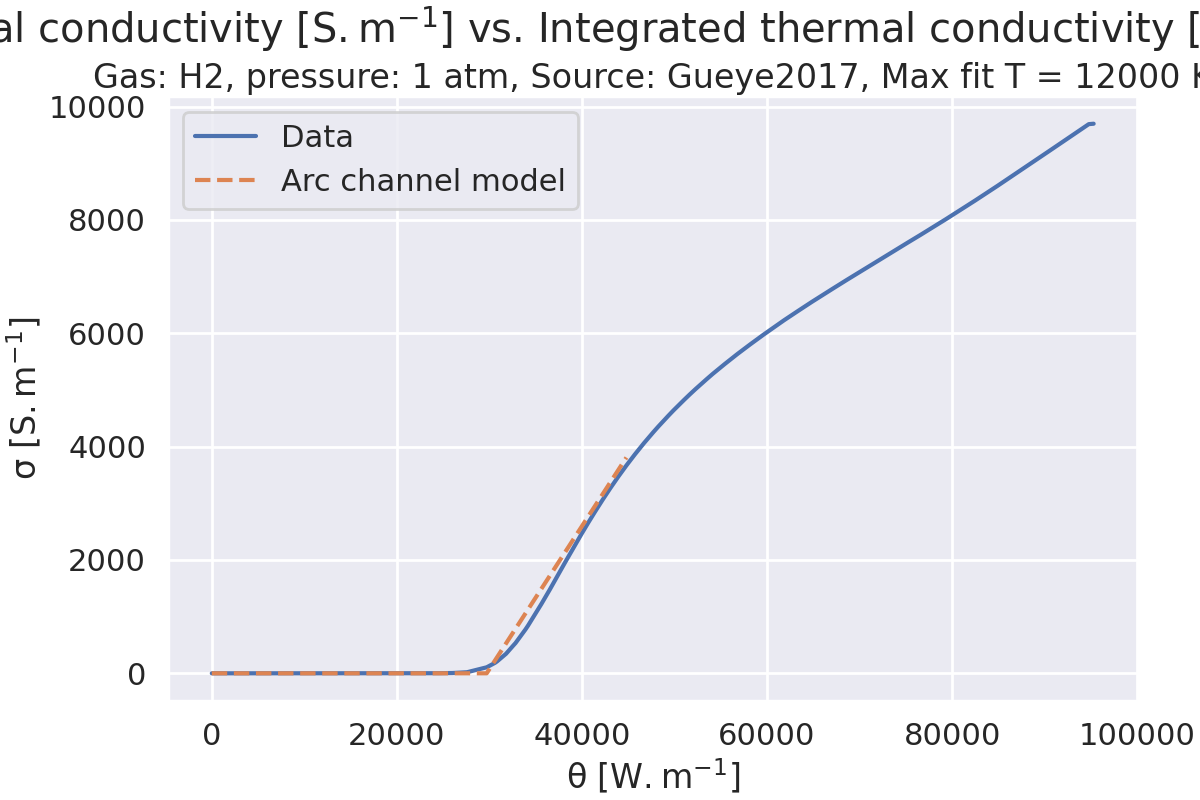
Plot electric field vs. current.
test_fig13a(plot=True)
![Electrical conductivity $\mathregular{[S.m^{-1}]}$ vs. Integrated thermal conductivity $\mathregular{[W.m^{-1}]}$, Gas: H2, pressure: 1 atm, Source: Gueye2017, Max fit T = 12000 K](../../_images/sphx_glr_plot_elenbaas_heller_model_009.png)
![Net Emission Coefficient $\mathregular{[W.m^{-3}.sr^{-1}]}$ vs. Integrated Thermal Conductivity $\mathregular{[W.m^{-1}]}$, Net Emission Coefficient fit, Max fit T = 12000 K](../../_images/sphx_glr_plot_elenbaas_heller_model_010.png)
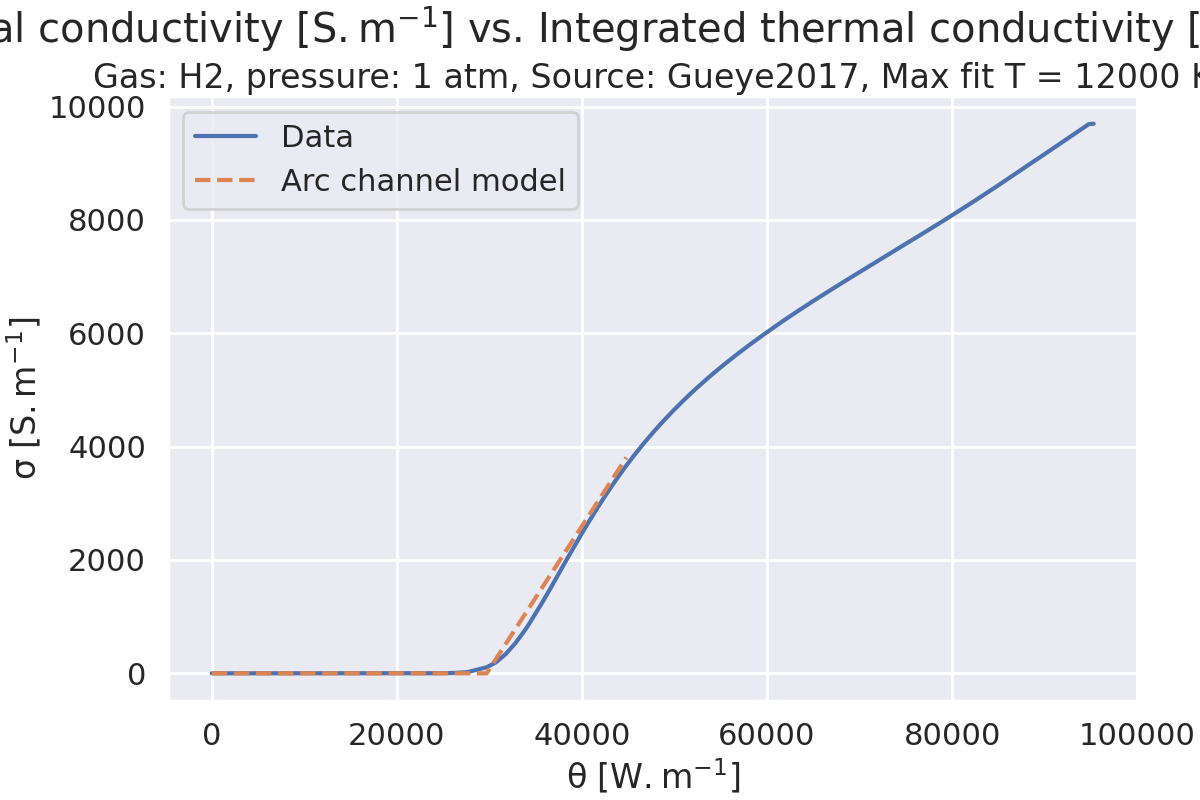
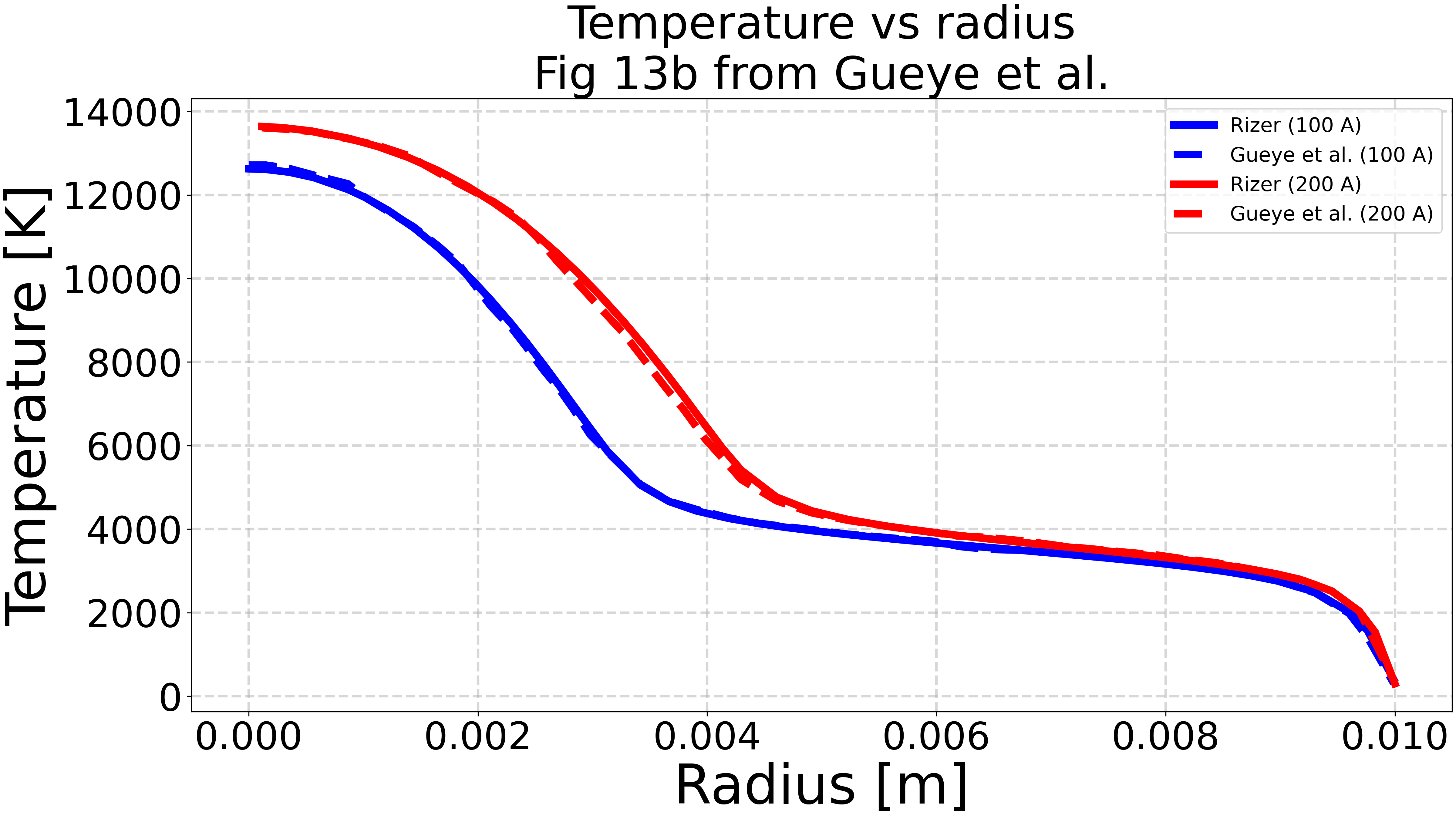
Plot temperature vs. radial distance for different current values.
test_fig13b(plot=True)
![Electrical conductivity $\mathregular{[S.m^{-1}]}$ vs. Integrated thermal conductivity $\mathregular{[W.m^{-1}]}$, Gas: H2, pressure: 1 atm, Source: Gueye2017, Max fit T = 12000 K](../../_images/sphx_glr_plot_elenbaas_heller_model_012.png)
![Net Emission Coefficient $\mathregular{[W.m^{-3}.sr^{-1}]}$ vs. Integrated Thermal Conductivity $\mathregular{[W.m^{-1}]}$, Net Emission Coefficient fit, Max fit T = 12000 K](../../_images/sphx_glr_plot_elenbaas_heller_model_013.png)
Total running time of the script: (0 minutes 11.430 seconds)