
Note
Go to the end to download the full example code.
Rempart Mechanism Validation.#
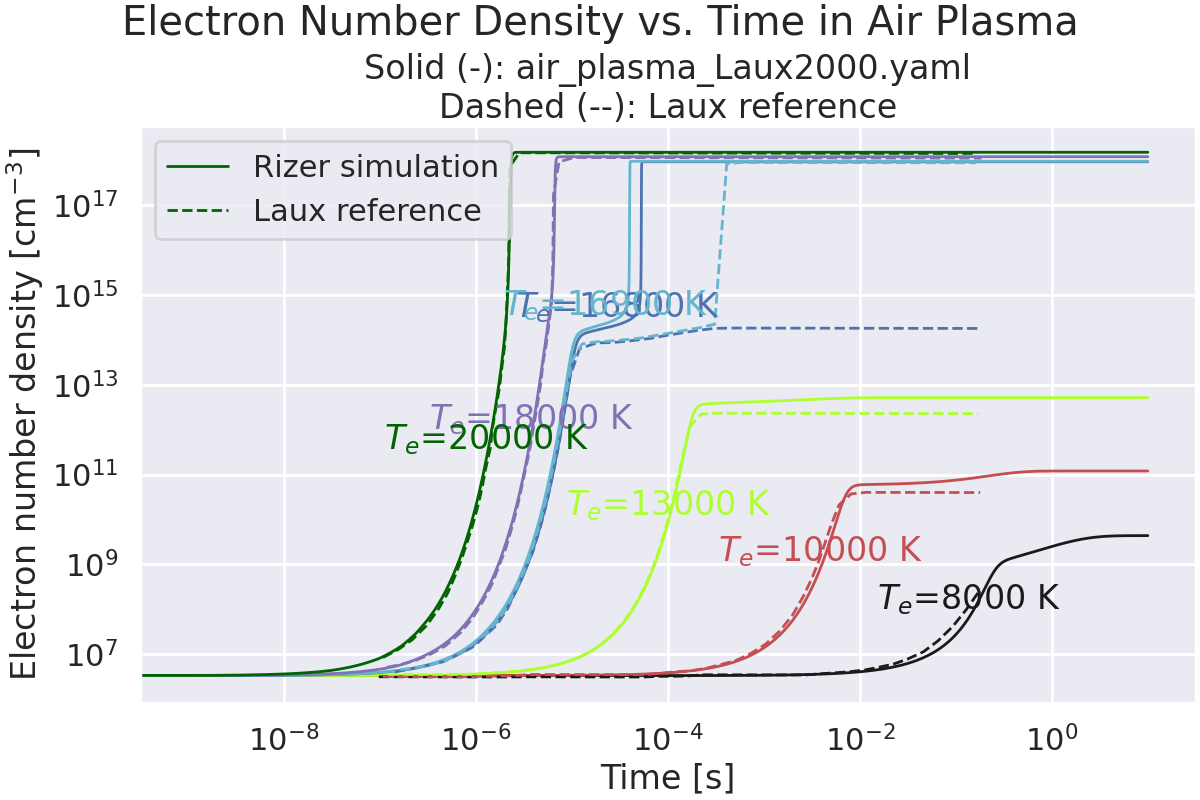
Validation case of Rizer code, as well as plasma air mechanism with Laux Rempart Project reference case.
Case: Two-temperature air plasma with ionization mechanisms from the Rempart Project.
Constant Gas Temperature: 2000 K
Constant Gas Pressure: 1 atm
Initial Electron Number Density: 3.3e6 \(cm^{-3}\)
Initial Mole Fraction of Air: O2=21%/N2=79%
Constant electron Temperatures: varied from 8000 to 20,000 K
Comparison with the Laux reference case ([LauxLecture]), with the evolution of electron number density.
Notes#
There are two references for the ionization mechanisms in the Rempart Project.
The first one ([Laux2000]) is the original paper by Christophe Laux, while the second one ([LauxLecture]) is a plasma lecture by Christophe Laux. In the original paper, there are 38 reactions (including backward reactions for electronic reactions), and the electron temperature range is from 8000 to 18000 K. In the lecture, there are 40 reactions (but not backward reactions), and the electron temperature range is from 8000 to 20000 K.
Reactions in the present mechanism come from [Laux2000]. The last 2 reactions are added from [LauxLecture].
Import the required libraries.#
import cantera as ct
import matplotlib.pyplot as plt
import numpy as np

import rizer.misc.units as u
from rizer.misc.plt_utils import get_text, set_mpl_style
from rizer.misc.utils import get_path_to_data
from rizer.models.nrp.isomass_2T_isobaric_reactor import Isomass2TIsobaricReactor
from rizer.transport.collision_frequency import MomentumTransferCollisionFrequencyModel
from rizer.transport.loaders import get_momentum_transfer_collision_frequency_model

set_mpl_style(nb_columns=1)
Load data from Laux’ lecture [LauxLecture].#
# Validation case of C.O. Laux Two-temperature model.
electron_temperatures_K = [
    8000,
    10000,
    13000,
    16800,
    16900,
    18000,
    20000,
]
data_laux: list[
    tuple[np.ndarray, np.ndarray]
] = []  # List of tuples with time and electron number density.
for T_e in electron_temperatures_K:
    file = get_path_to_data("papers", "LauxLecture2023", f"{T_e}K.csv")
    time, ne = np.genfromtxt(file, delimiter=",", unpack=True, skip_header=3)
    data_laux.append((time, ne))
Parameters for the simulation.#
# Initial condition.
P = ct.one_atm
T0 = 2000  # K
N0_cm3 = (P / u.k_b / T0) * 1e-6  # Initial gas density, cm^-3
n_e_0 = 3.3e6  # Initial electron density, cm^-3
x_e_0 = n_e_0 / N0_cm3  # mole fraction

# Calculation parameters.
t_start = 1e-9  # s
t_end = 1e-1  # s
N_POINTS_STORED = 1_000  # Number of points stored in the SolutionArray.
t_array = np.geomspace(t_start, t_end, N_POINTS_STORED)
Create the plasma mechanism object.#
# Define the paths to the plasma mechanism
plasma_mechanism = get_path_to_data("mechanisms", "air_plasma_Laux2000.yaml")
# Load the plasma Solution object.
plasma = ct.Solution(
    plasma_mechanism,
    name="plasma",
    transport_model=None,
)

momentum_transfer_collision_frequencies_list: list[
    MomentumTransferCollisionFrequencyModel
] = []
for plasma_species_name in plasma.species_names:
    momentum_transfer_collision_frequencies_list.append(
        get_momentum_transfer_collision_frequency_model(
            plasma_species_name,
            use_default_radius=True,
            use_first_available=True,
            default_radius=1e-10,
        )
    )
WARNING:root:Cross section data for N not found in the database. Using default radius of 1e-10 m.
WARNING:root:No elastic cross section data found for N in the LXCat database. Using default radius of 1e-10 m.
WARNING:root:Cross section data for NO not found in the database. Using default radius of 1e-10 m.
WARNING:root:No elastic cross section data found for NO in the LXCat database. Using default radius of 1e-10 m.
WARNING:root:Collision N2 <-> N2*(?) was already in the database and has been replaced.
WARNING:root:Collision N2 was already in the database and has been replaced.
WARNING:root:Collision N2 was already in the database and has been replaced.
WARNING:root:Collision N2 was already in the database and has been replaced.
WARNING:root:Collision N2 was already in the database and has been replaced.
WARNING:root:Collision N2 was already in the database and has been replaced.
WARNING:root:Collision N2 -> N2^+ was already in the database and has been replaced.
WARNING:root:Collision N2 -> N2(rot) was already in the database and has been replaced.
WARNING:root:Multiple cross section data files found for N2. Using the first one: /home/runner/work/rizer/rizer/data/cross_sections/lxcat_cross_sections/N2/Biagi.txt.
WARNING:root:No elastic cross section data found for O2 in the LXCat database. Using default radius of 1e-10 m.
Run the simulation for each electron temperature.#
result_states: dict[
    int, ct.SolutionArray
] = {}  # Store the results for each electron temperature.

for Te_K in electron_temperatures_K:
    print(f"Running for T_e0 = {Te_K} K")
    print("====================================")
    # Set the initial condition.
    plasma.Te = Te_K  # Set the electron temperature.
    plasma.TPX = T0, P, f"O2:0.21, e-:{x_e_0:.1e}, O2+:{x_e_0:.1e}, N2:0.79"
    print(f"Initial electron temperature: {plasma.Te:.2f} K")

    # Set up the reactor and network.
    reactor = Isomass2TIsobaricReactor(
        plasma,
        momentum_transfer_collision_frequencies_list,
        compute_Tg=False,
    )
    net = ct.ReactorNet([reactor])

    # Integrate the equations, keeping T(t) and Y(k,t).
    states = ct.SolutionArray(plasma, 1, extra={"t": [0.0]})
    i = 0
    try:
        while i < len(t_array):
            net.advance(t_array[i])
            states.append(plasma.state, t=net.time)  # type: ignore

            if i % 100 == 0:
                print(f"t={t_array[i]:.2e}/{t_end:.2e}")

            i += 1
    # Even if there is an error, we want to keep the results.
    except ct.CanteraError:
        pass
    finally:
        result_states[Te_K] = states


print("All results have been computed!")
Running for T_e0 = 8000 K
====================================
Initial electron temperature: 8000.00 K
t=1.00e-09/1.00e-01
t=6.32e-09/1.00e-01
t=4.00e-08/1.00e-01
t=2.53e-07/1.00e-01
t=1.60e-06/1.00e-01
t=1.01e-05/1.00e-01
t=6.38e-05/1.00e-01
t=4.03e-04/1.00e-01
t=2.55e-03/1.00e-01
t=1.61e-02/1.00e-01
Running for T_e0 = 10000 K
====================================
Initial electron temperature: 10000.00 K
t=1.00e-09/1.00e-01
t=6.32e-09/1.00e-01
t=4.00e-08/1.00e-01
t=2.53e-07/1.00e-01
t=1.60e-06/1.00e-01
t=1.01e-05/1.00e-01
t=6.38e-05/1.00e-01
t=4.03e-04/1.00e-01
t=2.55e-03/1.00e-01
t=1.61e-02/1.00e-01
Running for T_e0 = 13000 K
====================================
Initial electron temperature: 13000.00 K
t=1.00e-09/1.00e-01
t=6.32e-09/1.00e-01
t=4.00e-08/1.00e-01
t=2.53e-07/1.00e-01
t=1.60e-06/1.00e-01
t=1.01e-05/1.00e-01
t=6.38e-05/1.00e-01
t=4.03e-04/1.00e-01
t=2.55e-03/1.00e-01
t=1.61e-02/1.00e-01
Running for T_e0 = 16800 K
====================================
Initial electron temperature: 16800.00 K
t=1.00e-09/1.00e-01
t=6.32e-09/1.00e-01
t=4.00e-08/1.00e-01
t=2.53e-07/1.00e-01
t=1.60e-06/1.00e-01
t=1.01e-05/1.00e-01
t=6.38e-05/1.00e-01
t=4.03e-04/1.00e-01
t=2.55e-03/1.00e-01
t=1.61e-02/1.00e-01
Running for T_e0 = 16900 K
====================================
Initial electron temperature: 16900.00 K
t=1.00e-09/1.00e-01
t=6.32e-09/1.00e-01
t=4.00e-08/1.00e-01
t=2.53e-07/1.00e-01
t=1.60e-06/1.00e-01
t=1.01e-05/1.00e-01
t=6.38e-05/1.00e-01
t=4.03e-04/1.00e-01
t=2.55e-03/1.00e-01
t=1.61e-02/1.00e-01
Running for T_e0 = 18000 K
====================================
Initial electron temperature: 18000.00 K
t=1.00e-09/1.00e-01
t=6.32e-09/1.00e-01
t=4.00e-08/1.00e-01
t=2.53e-07/1.00e-01
t=1.60e-06/1.00e-01
t=1.01e-05/1.00e-01
t=6.38e-05/1.00e-01
t=4.03e-04/1.00e-01
t=2.55e-03/1.00e-01
t=1.61e-02/1.00e-01
Running for T_e0 = 20000 K
====================================
Initial electron temperature: 20000.00 K
t=1.00e-09/1.00e-01
t=6.32e-09/1.00e-01
t=4.00e-08/1.00e-01
t=2.53e-07/1.00e-01
t=1.60e-06/1.00e-01
t=1.01e-05/1.00e-01
t=6.38e-05/1.00e-01
t=4.03e-04/1.00e-01
t=2.55e-03/1.00e-01
t=1.61e-02/1.00e-01
All results have been computed!
Plot the results.#
fig, ax = plt.subplots()

# Colors for the plot.
colors_array = ["k", "r", "greenyellow", "b", "c", "m", "darkgreen"]
colors = {T_eV: color for T_eV, color in zip(electron_temperatures_K, colors_array)}

# Plot the simulation results.
for Te_K, states in result_states.items():
    (line_simulation,) = ax.plot(
        states.t,  # type: ignore
        states("e-").X * N0_cm3,
        label=f"$T_e$ {Te_K:.0f} K",
        color=colors[Te_K],
        ls="-",
        # lw=2,
    )
    # Add the electronic temperature as a text annotation.
    # .. Get the index of the max derivative.
    x_e = states("e-").X[:, 0]
    t = states.t  # type: ignore
    idx_max_derivative = np.argmax(np.gradient(x_e, t))
    # .. Remove some idx to focus on the ascending gradient.
    idx_wanted = idx_max_derivative - 80
    get_text(
        float(states.t[idx_wanted]),  # type: ignore
        float(states("e-").X[idx_wanted][0] * N0_cm3),
        r"$T_\text{e}$=" + f"{Te_K:.0f} K",
        ax=ax,
        color=colors[Te_K],
    )

# Plot the Laux reference data for comparison.
for T_e_in_K, (time_array, electron_density_array) in zip(
    electron_temperatures_K, data_laux
):
    (line_reference,) = ax.plot(
        time_array,
        electron_density_array,
        color=colors[T_e_in_K],
        ls="--",
    )


# Plot settings.
ax.set_xlabel("Time [s]")
ax.set_ylabel(r"$n_\text{e}$ [$\mathregular{cm^{-3}}$]")
ax.legend(
    [line_simulation, line_reference],
    ["Rizer simulation", "Laux reference"],
    fontsize=16,
    loc="upper left",
)
fig.suptitle("Electron Number Density vs. Time in Air Plasma")
title = f"Solid (-): {plasma_mechanism.name}\n"
title += "Dashed (--): Laux reference"
ax.set_title(title)
ax.set_xscale("log")
ax.set_yscale("log")
ax.grid(True, which="both", ls="--", lw=1)
plt.show()
Total running time of the script: (0 minutes 9.625 seconds)